Gateway Recovery Opens the Gate to Recycling and Innovation

Evidence suggests that as early as prehistoric times man recycled materials, demonstrating an understanding of resourcefulness. Throughout the centuries forward-thinkers have continued to develop processes to recover and recycle paper, rubber, metal, and other recyclable materials. Today most families instinctively separate their papers, cans, and bottles in their efforts to reduce waste and minimize the environmental impact. What is a simple daily task for families becomes much more problematic for manufacturers as scrap metals are no longer measured in pounds but tons. Gateway Recovery in Taylorsville, North Carolina, however, offers local and regional cable manufacturers a very real and even lucrative solution while they open the gate for a new innovative recycled product all their own.
 Gateway Recovery was already a thriving business when Jacob Lubbe bought the company not a decade ago. “I bought the company at the end of 2016,” Lubbe recalls. “At that time, we were located in Statesville. The business model the previous owner had was a pretty good model. We would buy the material, compact it, bale it, and ship it to China.”
The complexion of that model changed significantly in January 2018 when China enforced import bans that included 24 categories of recyclable materials. In March of 2018, they followed the initial ban with the announcement of an increased quality standard that scrap material imports must meet, and in December 2018 they added 16 additional solid waste scrap materials to the ban. These import bans, however, opened the gate for companies like Gateway Recovery to refine their processes for less contamination of their recyclable materials.
“So, two years into my owning the company, our Chinese buyers said they didn’t want our cables anymore,” Lubbe explains. “Needless to say, we were scrambling a little bit.”
He continues, “When you look at our insulated cables, you have this interesting mix of metallurgically mixed copper and aluminum that are metallurgically bound. You can’t separate them. You have a product that is a mixture of two metals. Unfortunately, the buyers who want copper don’t like aluminum, and those who want aluminum don’t like copper.”
Lubbe was confronted with the challenge of separating the bimetal from the plastic housing and then finding companies that would buy this ‘mixed metal.’ “Now we’ve done all that,” Lubbe says. “We’re selling the aluminum and the copper as a raw material to a refinery where they make zinc alloys, who knew.”
 Expanding his product line, Lubbe has successfully penetrated a market where other companies chose not to go. He explains, “We’re not the traditional scrap yard. We’re not a junk yard. Nothing is done outside. We don’t buy from the public. We only get our material from industrial manufacturers which means I pay a pricey sum for production grade scrap. So, when the manufacturer starts up a production line, the initial cable may not be dimensionally correct or there may be something wrong with it. That’s what we buy.”
Gateway Recovery now purchases materials from more than 80 companies. While their refined processes successfully created quality recycled metals for buyers throughout the world, Lubbe realized a new byproduct. “As we were making all this beautiful metal,” he laughs, “we were suddenly filling truckloads with plastic. First, we tried to sell the plastic, but unfortunately the insulated cables contain two different plastics. So, you have a mixed product which was strike one. Second, while we can separate the materials so that there is no plastic in the metal, there is still going to be a little metal in the plastic, strike two. Finally, this stuff was fluffy and light. If you ship it over the highway, the transportation cost would be ridiculous, strike three.”
As a forward-thinking organization committed to recycling, the Gateway Recovery management team researched the options of what they could do with all the residual plastic. “My brother and I found a guy on YouTube who teaches people how to recycle plastic,” Lubbe shares. “Following his model, you can build your own extruder with basic parts you can buy from Amazon.
We had enough spare parts here to build our own mini-extruder, and we had our own proof of concept. We proved to ourselves we can take this plastic, put it into the machine, heat it up, melt it, and make a shape that will hold. It is something real. It comes out beautiful. It comes out like something made.”
 The big question, however, was could they scale the process up? Continuing their research, Lubbe discovered that large extruders could cost as much as $250,000. Unwilling to invest that much in an unproven product, he purchased an old extruder for the price of scrap metal. “We brought it here, and we quickly learned what it means when machinery has been out of commission for 25 years,” he laughs. “We rewired it, rebuilt the controls, and we made a bigger piece which was a 9 foot long, 4 X 4. We were jumping around like it was Christmas morning, it was validation.”
Lubbe realizes, however, that the only real validation of any new product is a buyer. “Despite all the talk about recycling, and people getting excited about recycling, I’ve had a pretty hard time selling this,” he admits.
Market research suggests that the companies that started manufacturing a similar product 10 to 15 years ago charged an exorbitant price for it. Home Depot or Lowe’s, for example, sell a 4 in. x 4 in. x 8 ft. black recycled plastic lumber for gardening purposes for approximately $55 apiece whereas a piece of wood is only about $10. “When I did the math to see how they could justify charging that much, I realized that’s what they have to charge in order to make money,” Lubbe shares. “We think we can sell it for less than $20.”
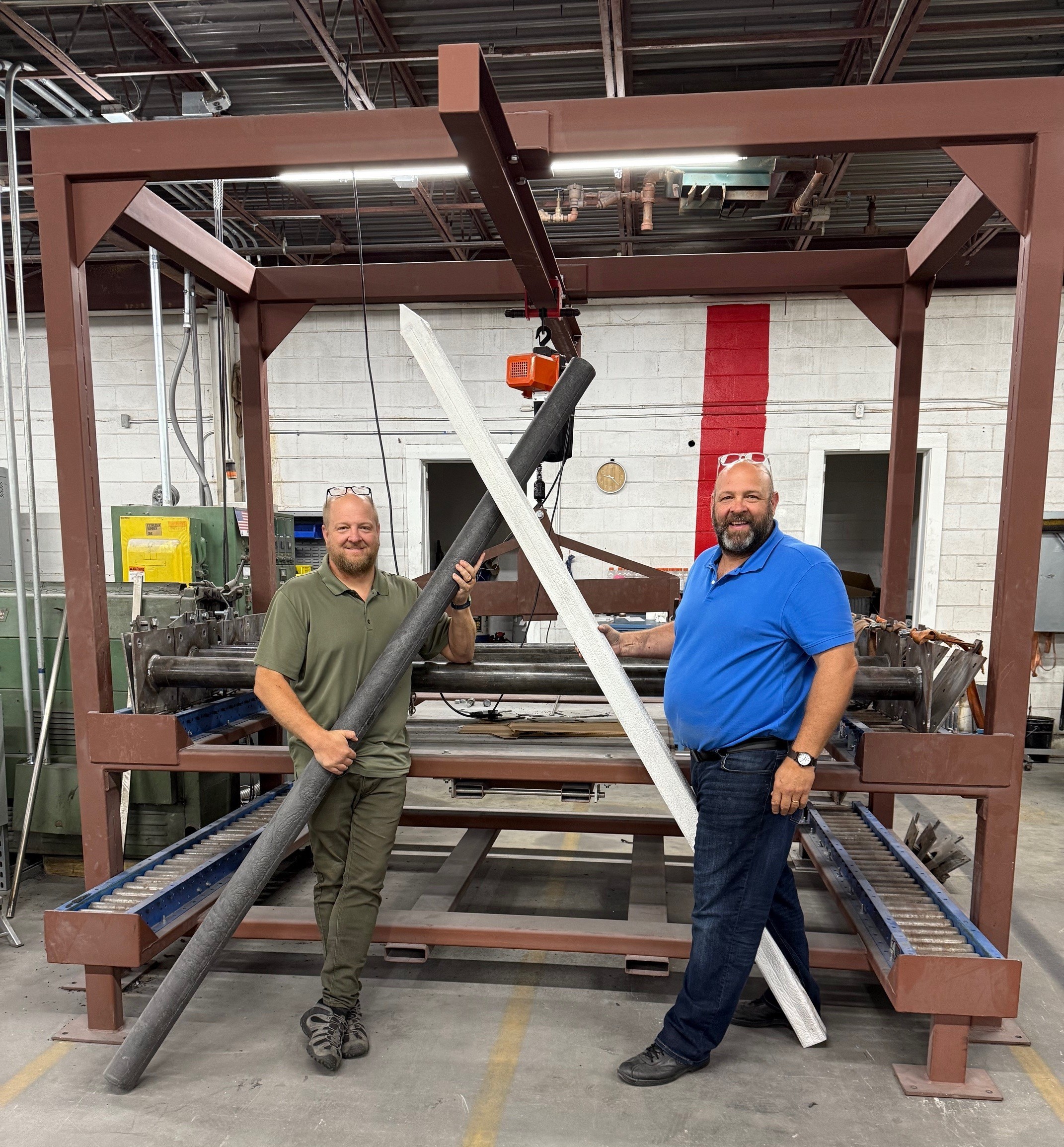
 Utilizing discreet molds, Gateway Recovery has successfully manufactured 4 X 4’s, 6 X 6’s, 2 X 4’s, 2 X 6’s, and 4” rounds. While the goal is to manufacture a product to compete with wood, the result is as much as five times stronger than wood. Lubbe explains, “They key is that this material will not rot. It can be used as a wood replacement in fencing and basic deck substructure. But it will never rot.”
As strong and sturdy as these timbers are, they can be cut, hammered, or screwed with the exact same equipment as wood.
According to Lubbe, the ideal applications are anything outdoor where real wood deteriorates over time. “It’s a pretty product. The plastic we use has a built-in UV filter. The white fences you see are PVC, but with that, they incorporate an additive. After 5 years, you can still poke your finger through it. Whereas this is naturally UV resistant. I have put pieces in the sun. After a year, they look like I put it there yesterday. They are still shiny.”
Lubbe is so convinced of the viability of the product that he has made sample pieces available for free. “I just want to get the word out,” he laughs. “I tell people to try it. Build something. If they like it, send pictures, or better yet, tell your friends!”
The gates for this innovative new product are now open at Gateway Recovery. To learn more about Gateway Recovery or how to get lumber samples at www.gatewayrecovery.net . The plastic website is: www.grpinc.net
 Previous