North Carolina Department of Commerce Gauges Counties’ Vitality
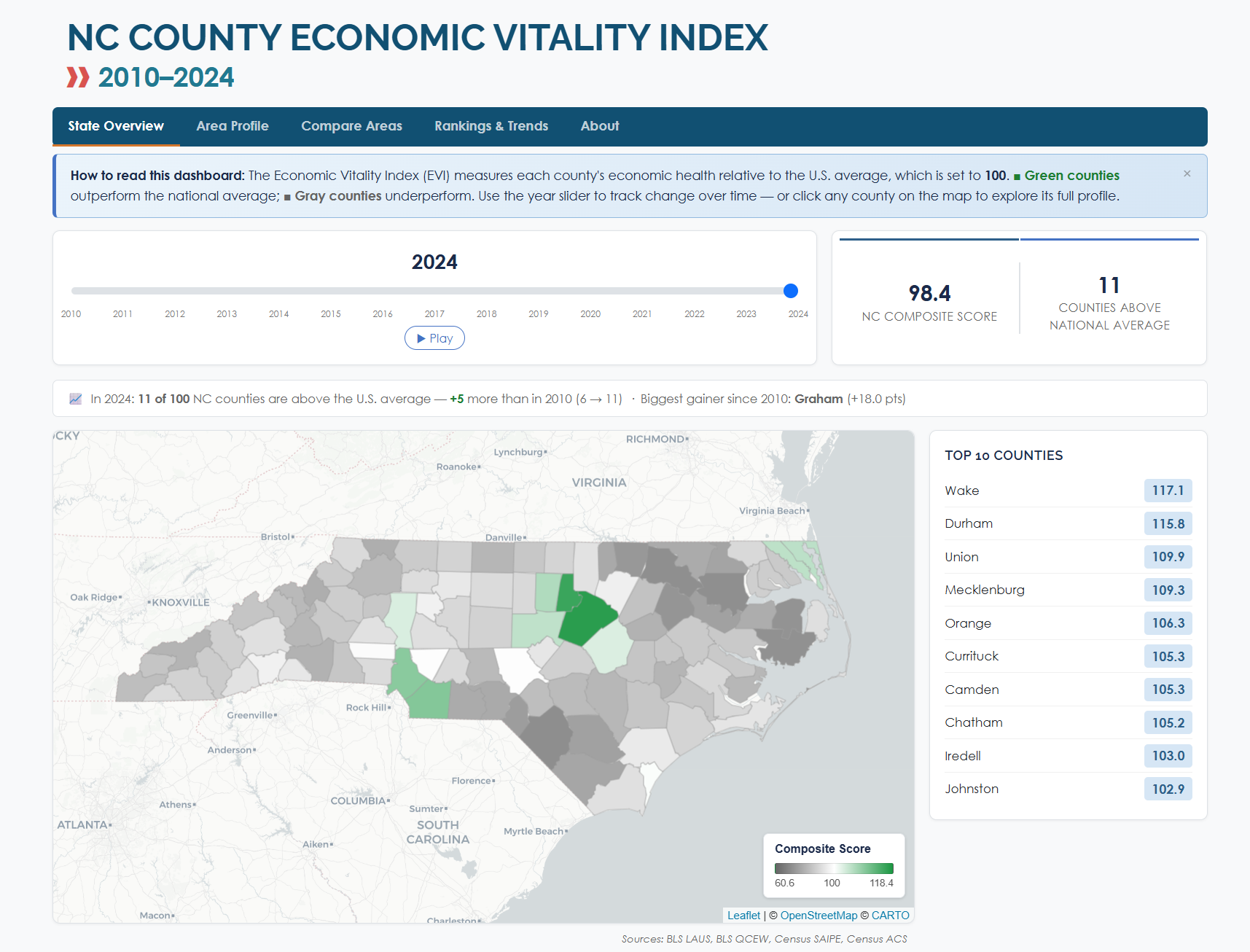
State Commerce Department officials have created an “economic vitality” dashboard to help gauge how well North Carolina’s counties are faring relative to others and to the country as a whole.
It uses a composite set of metrics, namely average unemployment rates, private sector weekly wages, median household income and percentage of adults age 25 and up who have at least a high school diploma.
The report shows that the state’s prosperity remains mostly an urban phenomenon, with some suburbs and coastal areas sharing in it.
Only 11 counties of 100 scored higher than the national average for vitality in 2024.
These include five urban counties: Wake, Durham, Mecklenburg, Orange and New Hanover. Union, Chatham, Johnston and Iredell led the way for the suburbs, while coastal counties Camden and Currituck also excelled.
Another seven counties — Moore, Cabarrus, Lincoln, Henderson, Davie, Franklin and Pender — are “quickly closing in” on the U.S. average, Commerce says.
Three urban counties, Guilford, Forsyth and Buncombe, lag the national average and their counterparts. Guilford has hovered in the same range for a decade and a half, with wages and education levels dropping off in that time to offset gains in employment.
Forsyth likewise has seen a drop-off in wages since 2017.
Buncombe County saw a sharp drop in employment in 2024, the year of Hurricane Helene. It’s only come close to hitting the national average once, in 2014. Wages are consistently on the low side, even though median household incomes have been rising.
Notable decliners since 2010 include Cumberland and Watauga counties. Cumberland saw long-term declines in the four key metrics. Watauga’s relative unemployment levels have fluctuated considerably, dipping below the national average in 2017 and 2019. Wages there are consistently low.
Orange County is a recent decliner, with a notable dip in household incomes since 2020, dropping to the same relative level as in 2010.
 Previous